Dating a widower at the holidays
The house, the family gathering, a hard date on the calendar, a gift: each one can stir grief and still leave room for you. You are not competing with the person who died. You are deciding whether there is a life here that includes both the loss and a future.
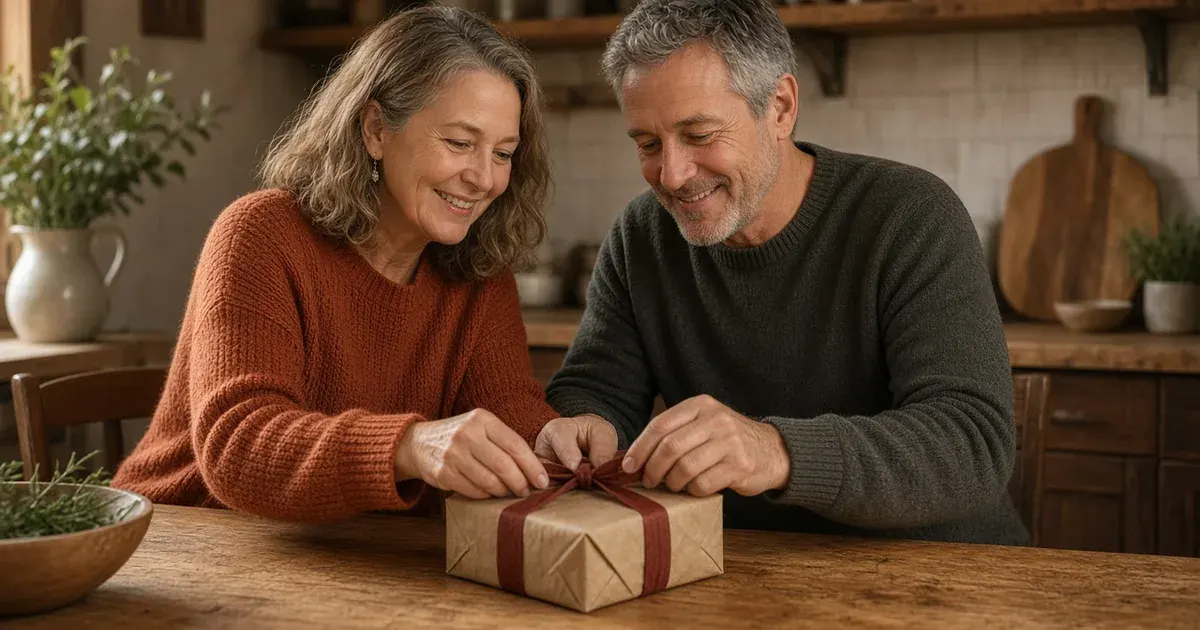
The holidays concentrate a life that already had another chapter. A tree goes up the way it used to. A toast skips a name, or includes one. A family gathering still has a shape that was built before you arrived.
None of that automatically means there is no room for you. It does mean the season will not be a blank slate.
This is about getting through the holiday with a partner who is widowed, not about the jealousy itself. If that is the main ache, we have a related piece on dating someone with adult children.
Is there a right timeline for their grief?
No, and anyone who offers you one is guessing.
An AARP advice column published in January 2026 is blunt about that. Certified sex therapist Marianne Brandon says the instinct to approach a widow or widower with respect, rather than with assumptions, is the right one.1 Many people, she says, feel two truths at once: ongoing love for the person they lost, and openness to a new chapter.1 Sexuality educator Jane Fleishman adds that some people want to date or remarry, and some do not want to date at all.1 There is no single schedule.
Joan Price, writing for Senior Planet from AARP, tells a man who feels he is competing with a late husband the same thing in different words. Two seemingly contradictory things can be happening: she is still grieving, and she is forming a new emotional connection with you.2 “You are not in competition with her deceased husband. You only hurt yourself and the relationship by thinking that you are.”2 The photos, the jewelry, the stories, she argues, do not have to be packed away for the new relationship to be real.2
A Psychology Today essay on the romantic life of widows makes a similar point: some people describe a continuing bond with a late spouse alongside a new relationship, and tension rises when a new partner needs that first marriage to recede on a deadline.4
What is ordinary at the house, the gathering, the hard day, the gift?
At the house, keepsakes and stories are ordinary. Asking that they all disappear before Christmas is not a small request. Asking where you will sleep, whether you are welcome for the meal, and how they want you introduced, is reasonable.
At the family gathering, you may meet people who loved the person who died. You are a guest, not a replacement. A cool reception from an adult child is information, and it is not always the final word.
On the hard day, a quiet spell, a cancelled plan, or tears do not automatically mean you have failed. They may mean the calendar did what calendars do. Price’s column also has a practical warning: do not surprise them with a romantic trip to a place that was already theirs on holidays, or on a date you have not checked.2 Ask first.
A gift can be simple. It does not need to compete with a memory. It can be a new tradition in miniature. Sophia Dembling, writing in Psychology Today after her husband’s death, describes building holiday rituals slowly, sometimes a small tree and a few new decorations, because the old box was still too much.3 Rebuilding, she says, happens a small step at a time.3
When is it worth a conversation?
When there is no room in the week for anything that includes you. When you are hidden from family, or asked to stay away indefinitely, with no path back. When every suggestion of a new ritual is treated as a betrayal, year after year. Compassion can run alongside a plain question: is there a future here that has a place for me, including on the days that hurt?
You can be patient with grief and still need a life, not only a seat at the edge of someone else’s past. Those are not opposites. The experts keep saying the both is the point.12
Try it
Is this ordinary holiday grief, or a conversation you need?
People who talk about this
- Credentialed source
Bella DePaulo
Research and writing on single life, including people who choose to stay single and live full lives on their own terms.
- Credentialed source
Marisa G. Franco
Friendship, loneliness and belonging, and how adults make and keep close friends.
- Credentialed source
Pepper Schwartz
Research and writing on love, sex and relationships, including dating and partnership later in life.
- Trending voice
Esther Perel
Desire, infidelity and the tensions inside long term relationships, often through real couples sessions on her podcast.
Further reading
University of Minnesota Extension
Your child's adjustment to your new romantic relationship (opens extension.umn.edu)How children of any age may react to a parent's new partner, and how to pace the introduction.