Dating a younger man in your 50s: what matters
The age gap itself predicts less than you'd think. What tends to matter is whether you want the same next ten years, and how much outside judgment the two of you let in. Talk about both early.
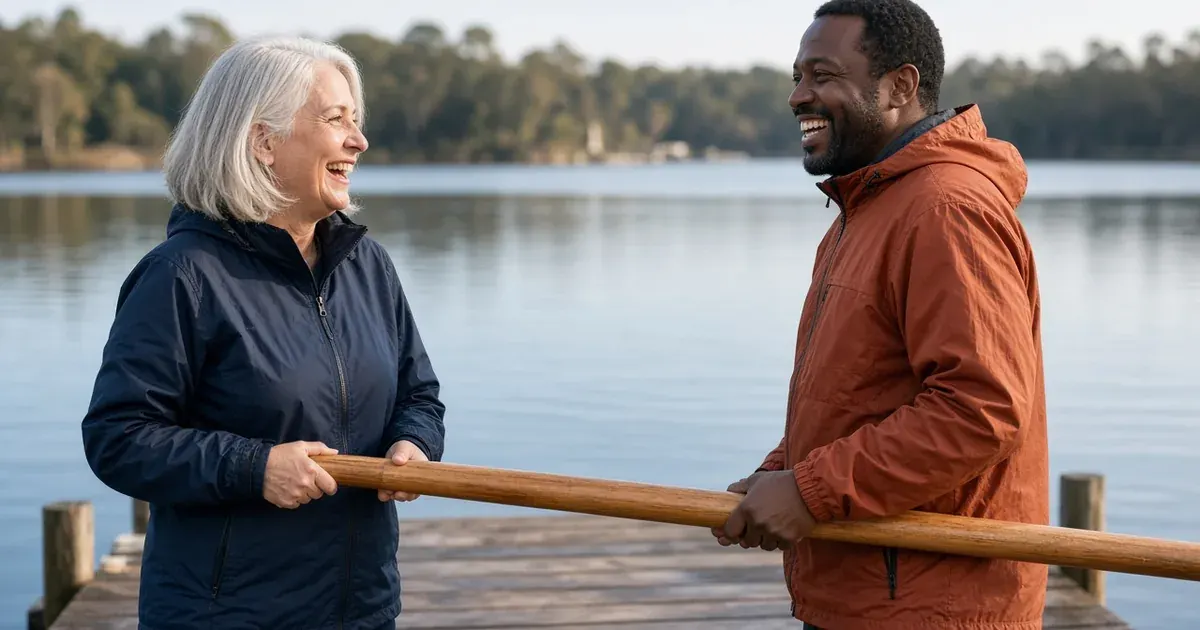
The age gap matters less than most people expect. Research on later-life couples finds that partners in age-gap relationships are, on most measures, about as satisfied as same-age couples. What tends to matter more is whether you want the same next ten years, and how much outside judgment you let into the relationship. Both are conversations, not verdicts, and they’re better had early.
Meet Delphine, a character we’ve made up for this piece. She’s 56, a dental hygienist, divorced eight years after a 24-year marriage, with two grown sons. For two months she’s been seeing Anselm, 44, a carpenter she met through her rowing club. He’s attentive, makes plans, and doesn’t seem to think twice about their age difference. She thinks about it a lot.
Separate what happened from what you fear
What happened: two good months with a man twelve years younger. The reading: this probably can’t last. The fear: her friends will joke, her sons will worry, and he’ll eventually want someone his own age. The next step: look at what the research actually finds, and have the conversation that matters.
What the research shows about later-life gaps
The best data on older age-gap couples comes from sociologist Tony Silva. Using two large national surveys of Americans, with an average age around 63, he found that people in age-gap partnerships were not very different from people in same-age relationships on most measures of life satisfaction and relationship well-being.1 The differences that did show up were mostly about sexual well-being among younger women with older men, which is the reverse of Delphine’s situation.1
The pattern also isn’t as unusual as it feels. An analysis of 600 personal ads found that women’s preferences shifted over the life span: women in the younger age groups asked for older men, while women 75 and over asked for younger ones.2 Men, meanwhile, wanted younger partners as they aged. Preferences in ads aren’t the same as actual relationships, but they show that age expectations change across life.
Research by Justin Lehmiller and Christopher Agnew went further. In their study of women in heterosexual relationships, those with younger partners reported the highest satisfaction and commitment, compared with women in same-age relationships or with older partners.3 That’s a single study, and it can’t say the age arrangement caused the satisfaction. But it doesn’t support the idea that these relationships are doomed.
The part that does weigh on couples
Outside judgment is real. In a separate study, the same researchers found that people who felt their relationship was looked down on by others tended to be less committed the more disapproval they felt.4 The surprise was that these couples, overall, were still more committed than average, apparently because they saw fewer appealing alternatives.4 The research doesn’t prove which way that runs. What it suggests is that disapproval is a pressure worth talking about together, rather than absorbing alone.
A review of 25 years of research on age-gap couples makes a related point: the field has moved away from asking whether these couples “work” and toward looking at how power, life stage and choice play out in each relationship.5 In other words, the useful questions are specific to the two of you.
The questions that matter more than the number
- Where are you each headed? If he’s building a career and you’re planning to scale back in five years, that’s worth naming.
- Grandchildren, aging parents, health. These come up sooner in your 50s than in his 40s. Not deal-breakers, just real calendars.
- Where would you live? A man who wants to stay near his work and a woman who’s thinking about moving closer to a grandchild have something to discuss.
- How do you each handle comments? From friends, from family, from strangers at a restaurant.
You don’t need all the answers by date eight. You need to know you can talk about them.
Delphine raised one of these over a Saturday dinner. She asked Anselm how he pictured his late 50s. He said he wasn’t sure, but he knew he didn’t want to spend them working weekends. Then he asked her the same question. It was the first time the age difference felt like something they were looking at together, instead of something she was guarding alone.
If you’re still deciding whether this is someone worth building with, read is this person right for you this time?. And for a broader look at the landscape, here’s what to expect dating in your 50s.
What doesn’t the research show?
- The large-survey data was mostly about older couples on average, not specifically women in their 50s with men in their 40s.
- The satisfaction finding comes from one study and is a correlation, not proof that a younger partner causes more satisfaction.
- Personal ad preferences aren’t relationships. What people ask for in an ad isn’t what they end up with.
- No study can tell you what he’ll want in ten years. Asking him, and watching over time, is better evidence.
Try it
Which part of this is actually on your mind?
Steal this text
Say it in your own words, or start from these
Opening the future question
I'm really enjoying this, and I'd like to understand where you see your life going in the next few years. Could we talk about it over dinner Saturday? No pressure for neat answers.
Talking about other people's opinions
My daughter asked about you last week, and I realized I was nervous about her reaction. I'd like us to talk about how we each want to handle that kind of thing.
People who talk about this
- Credentialed source
Bella DePaulo
Research and writing on single life, including people who choose to stay single and live full lives on their own terms.
- Credentialed source
Marisa G. Franco
Friendship, loneliness and belonging, and how adults make and keep close friends.
- Credentialed source
Pepper Schwartz
Research and writing on love, sex and relationships, including dating and partnership later in life.
- Trending voice
Esther Perel
Desire, infidelity and the tensions inside long term relationships, often through real couples sessions on her podcast.
Further reading
Greater Good Science Center, UC Berkeley
Four Reasons to Stay Single (opens greatergood.berkeley.edu)Makes the evidence-based case that a single life can be full, which helps clarify what you actually want.
Sources
- 'Daddies,' 'Cougars,' and Their Partners Past Midlife: Gender Attitudes and Relationship and Sexual Well-Being among Older Adults in Age-Heterogenous Partnerships
- Partner preferences across the life span: Online dating by older adults
- Commitment in Age-Gap Heterosexual Romantic Relationships: A Test of Evolutionary and Socio-Cultural Predictions
- Marginalized Relationships: The Impact of Social Disapproval on Romantic Relationship Commitment
- Age-dissimilar couple relationships: 25 years in review